Ripple
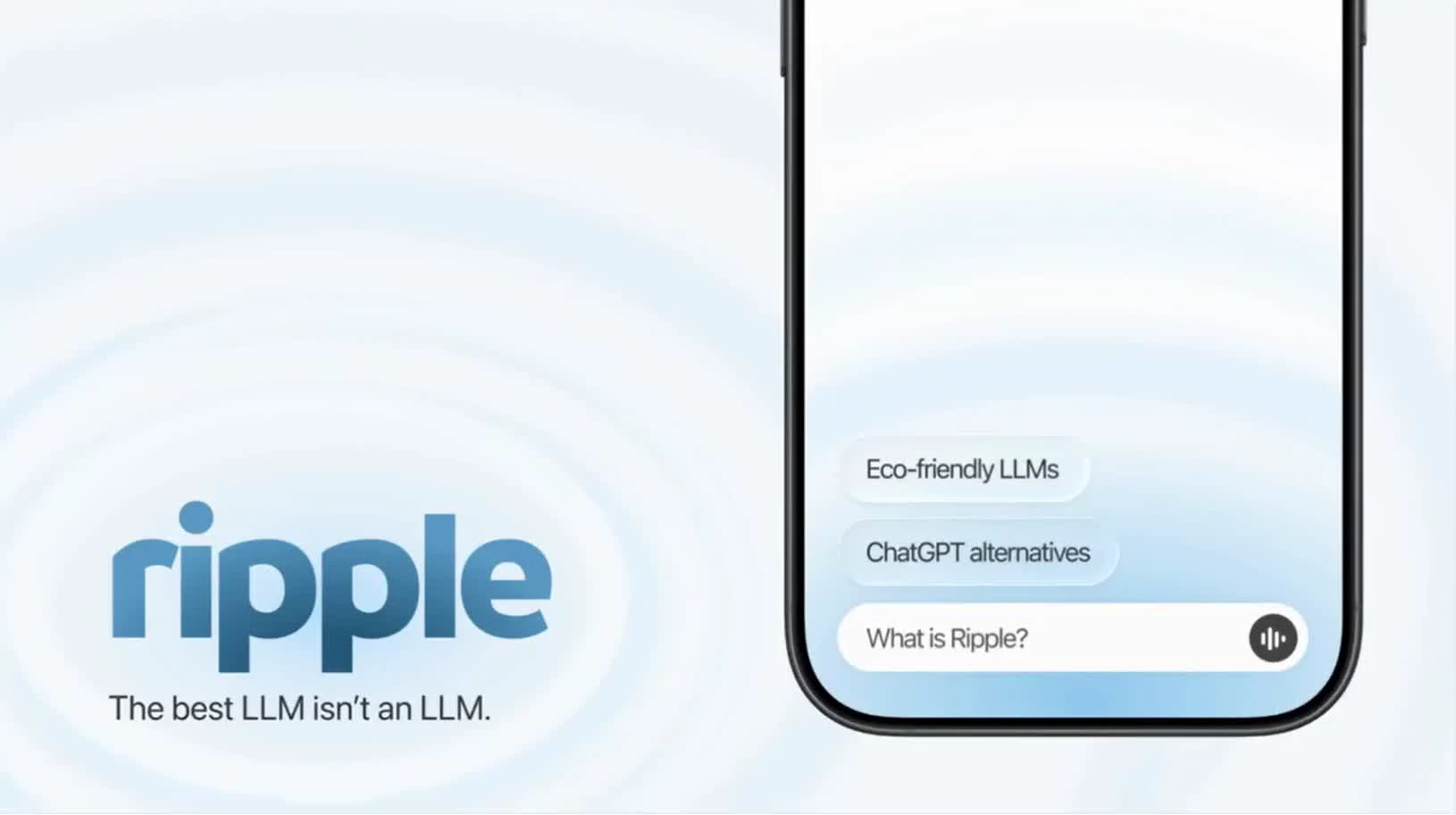
Ripple is an AI assistant that checks whether your question has already been answered before it generates a new answer. It resurfaces past answers first, falls back to an efficient model only when nothing fits, and shows each person how much water their questions saved.
- Role
- Research, concept, UI design, prototype and pitch
- Team
- Samuel Huang, Jonathan Zhou, Grace Yu, Lucas Vu
- Timeline
- 8 hours, UW/UX BLOOM Designathon, March 2026
- Scope
- Desk research, interviews, competitor review, product design
- Outcome
- 3rd place
The brief
We had eight hours to make sustainable action part of an everyday habit.
BLOOM, run by UW/UX and UW Blueprint, gave every team the same question and one working day to answer it with a designed product.
“How might we use design and technology to make climate awareness and sustainable action easier to understand and practice in everyday life?”
- Event
- UW/UX BLOOM Designathon 2026
- Time
- 8 hours
- Team
- 4 designers
- Result
- 3rd place
My role
I worked on every stage, from the research to the pitch.
In a team of four with eight hours, everyone touched everything. My part of it:
- Research: the papers and articles on what AI costs in water and energy, and conversations with students about how they use ChatGPT.
- Concept: choosing the problem and shaping the idea of reuse before regeneration.
- UI design: the home, answer, discover and profile screens.
- Prototype and pitch: the Figma prototype, and presenting it to the judges.
Finding the problem
We went looking for a habit people repeat every day, not a lifestyle change.
We mapped everyday actions with a climate cost and what each could become. We wanted an action where a small change, repeated, adds up, and one that people talk about less.
Finding the problem
We chose AI prompts because they are daily, invisible and rarely discussed.
We held each idea we had brainstormed against the two things we wanted: an action people repeat every day, and one that is not already the subject of every sustainability campaign.
A borrowing and sharing platform
- Repeated every day
- Rarely talked about
- Needs no new habit
Daily sustainability challenges
- Repeated every day
- Rarely talked about
- Needs no new habit
A reduce, reuse, recycle app
- Repeated every day
- Rarely talked about
- Needs no new habit
Asking an AI a question
- Repeated every day
- Rarely talked about
- Needs no new habit
| Repeated every day | Rarely talked about | Needs no new habit | |
|---|---|---|---|
| A borrowing and sharing platform | |||
| Daily sustainability challenges | |||
| A reduce, reuse, recycle app | |||
| Asking an AI a question |
The problem
We found that every AI answer has a cost nobody sees.
LLMs now answer everything from simple facts to questions asked a thousand times before, and the experience is so smooth that the data centre behind each answer disappears. The numbers we worked from:
- of water for roughly every 10 to 50 GPT-3 responses, to cool data centres. Li, Yang, Islam and Ren
- of water withdrawal projected for AI by 2027, at the upper estimate. Li, Yang, Islam and Ren
- the electricity of a Google search, for one ChatGPT query. EPRI
Insight #1
We noticed that many everyday questions have already been answered.
Simple searches are moving to chat, and the same question comes back in slightly different words. Each version is generated from scratch.
Insight #2
We realised that telling people to use AI less would never work.
AI is part of daily life now. A product that asks people to give it up loses before it starts; one that changes what happens underneath does not have to ask.
Ask people to change
- Use ChatGPT less
- Search before you prompt
- Feel bad about it
Change what happens underneath
- Ask the way you already do
- Get an existing answer if there is one
- See what that saved
Competitor review
I looked at where people ask questions today: none reuse an answer or show its cost.
The tools people already use answer questions well. None of them tell you an answer already exists, or what yours cost to make.
ChatGPT
- Familiar chat
- Reuses past answers first
- Shows the water and energy
Perplexity
- Familiar chat
- Reuses past answers first
- Shows the water and energy
Google Search
- Familiar chat
- Reuses past answers first
- Links to pages
- Shows the water and energy
Ripple
- Familiar chat
- Reuses past answers first
- Shows the water and energy
| Familiar chat | Reuses past answers first | Shows the water and energy | |
|---|---|---|---|
| ChatGPT | |||
| Perplexity | |||
| Google Search | Links to pages | ||
| Ripple |
The opportunity
So we asked a different question: why not redefine what it means to use an LLM?
AI isn't going anywhere, so instead of fighting it, we wanted to change how it works.
How might we make an everyday AI question cost less, without asking anyone to change how they ask it?
Solution
We designed Ripple to search before it generates.
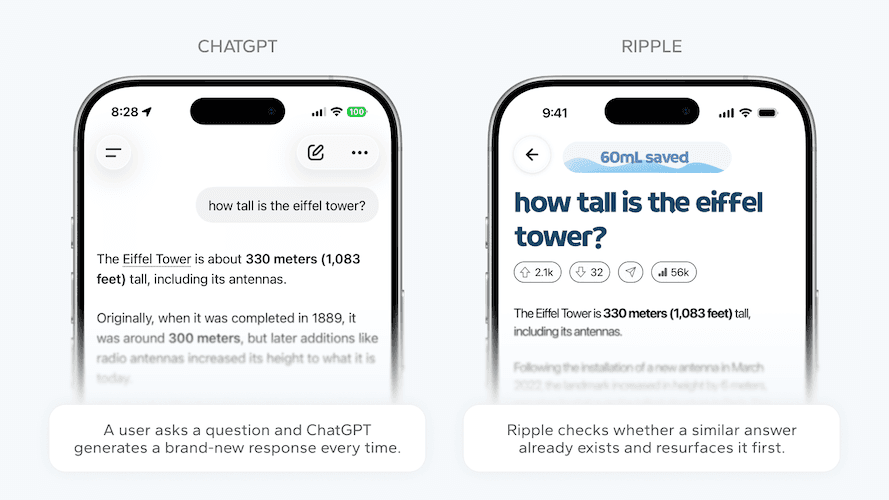
A question first goes to a library of answers that already exist. If one fits, Ripple shows it with what reusing it saved. Only when nothing fits does it generate, and then with an efficient, low-cost model.
Solution
We kept the answer the same and changed where it comes from.
Side by side, the difference is invisible to the person asking. That is the point.
Design decision
I kept the interface familiar, so nobody has to learn a new tool.
Ripple opens like ChatGPT: a prompt box and nothing else to learn. Type a question and the matching answers that already exist appear first, ready to pick.
Design decision
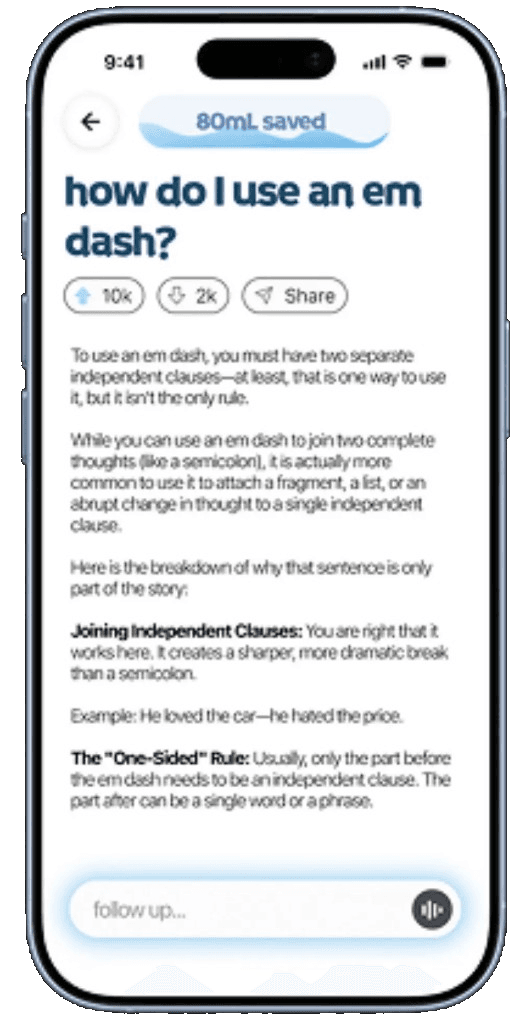
I designed the answer page so a reused answer earns trust at a glance.
A resurfaced answer has to show which question it answered, how others rated it, and that you can still keep going.
What it saved
Every reused answer says how much water it saved, in millilitres.
The question it answered
The original prompt sits on top, so you can judge the match yourself.
Votes
Up and down votes are how Ripple learns which answers fit best.
Follow up
Ask more and Ripple carries on like any chat.
Design decision
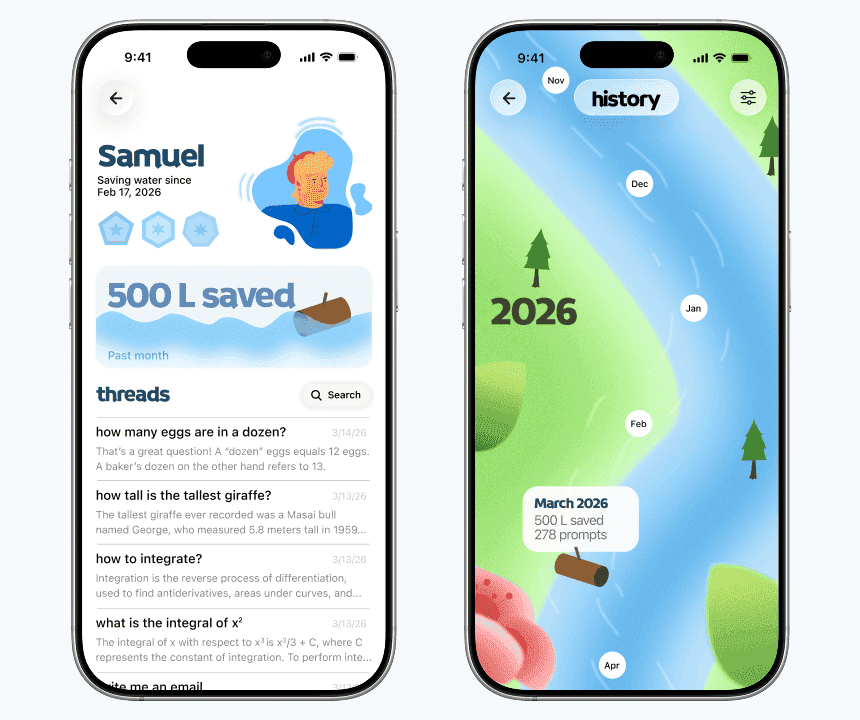
I made the saving visible, because people do not care about what they cannot see.
Water runs through the whole design. The profile counts the litres you saved this month, and a river of past questions, with badges at milestones, turns the saving into something you can watch grow.
Solution
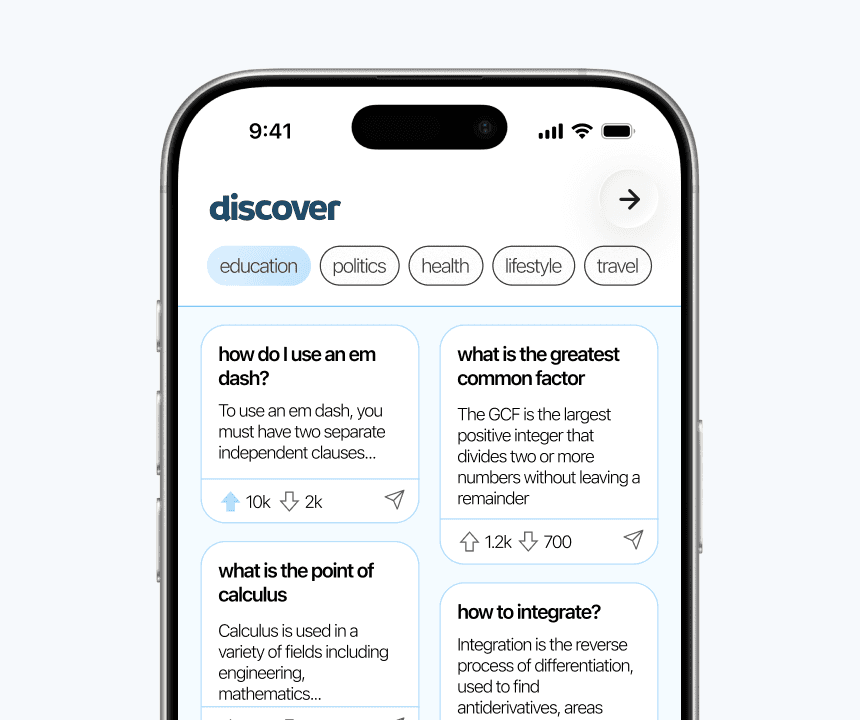
We added Discover so people can learn from answers that already exist.
Inspired by Ditto Lists, Discover lets you browse questions others have asked by category, and learn without generating anything new.
Prototype
We built the whole flow as a Figma prototype for the judges.
Ask, pick an existing answer, follow up, see the saving. Open it to try the flow yourself.
Outcome
We placed 3rd at BLOOM.
Out of the teams at UW/UX and UW Blueprint's designathon, in eight hours.
Ripple
Looking back
I went back to the research: the idea is stronger at scale than per prompt.
Since we worked from the 2023 estimate, Google and OpenAI have published their own per-prompt numbers, far lower. One prompt costs a few drops. Billions a day still add up.
Looking back
I'd make Ripple personal first, because that is where questions repeat.
Studies of semantic caching since have measured how often questions really repeat. Across everyone's public chats, rarely. Within one person's own history, often. A reused answer can also go out of date.
Key learnings
I learned to meet people where they are and to make the invisible visible.
- Don't reinvent the interface. People already know how to use ChatGPT, so Ripple looks and feels like it; the sustainability happens quietly underneath.
- Meet people where they are, not where you wish they were. Telling people to use AI less was never going to work; Ripple works with the habit instead.
- Make the invisible feel real. Water and energy are hidden in every LLM. If people can't see it they won't feel it, and if they don't feel it they won't care.
- Check the numbers again after the event. The case got more honest, and more interesting, once the per-prompt figures came down.
This is a snapshot of the process. Ask me for the full story.
say hi